Attic furnaces in Tomball homes: what fails and what to listen for
A furnace in the attic fails in familiar ways, and most of them announce themselves with a sound or a pattern.
October 21, 2026 · 4 min read
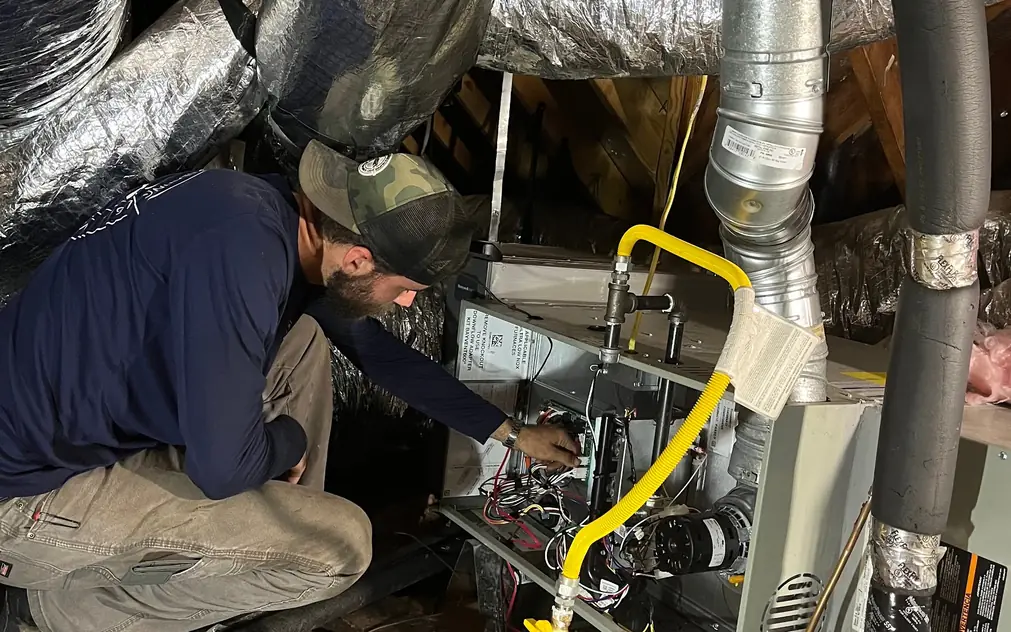
In a lot of Gulf Coast houses the furnace and the air handler share a cabinet in the attic, where they save floor space and sit close to the ducts. Out of sight is also out of mind. Most homeowners only learn how their furnace behaves when it stops, usually on the first cold morning after six months of silence. Knowing the common failures, and what each one sounds like, lets you describe the problem clearly and often shortens the repair.
How a gas furnace starts, step by step
A modern gas furnace runs a sequence every time the thermostat calls for heat. The inducer motor starts first and pulls air through the heat exchanger and out the vent. A pressure switch confirms that air is moving. The igniter heats up, the gas valve opens, and the burners light. A flame sensor confirms the flame is real, and after a short delay the blower starts pushing warm air into the ducts. If any step fails, the furnace stops and tries again, or shuts down for safety.
That sequence is why furnace problems are so repeatable. Each part fails at a particular point, and the point where your furnace gives up tells a technician where to look.
The parts that fail most often
The igniter is a common one. Most modern furnaces use a hot surface igniter, a fragile ceramic element that glows to light the gas. It cracks with age and heat cycles. When it fails you may hear the inducer run and the clicks of the sequence, but the burners never light and no warm air follows.
The flame sensor is another frequent offender. It is a thin metal rod that sits in the flame and proves to the control board that the burners are lit. Over time it builds a film of residue and stops sensing properly. The classic symptom is a furnace that lights, runs for a few seconds, and shuts off, then tries again a few times before locking out. A technician can clean it or replace it, and it is usually a quick job.
The limit switch is a safety device that shuts the burners off when the furnace gets too hot. It can fail, but a limit switch that trips is far more often reporting a real problem: restricted airflow from a dirty filter, a blocked return, or a blower that is not moving enough air. If your furnace runs, shuts down and the blower keeps going, check the filter before you check anything else.
The inducer motor and its pressure switch round out the usual list. A worn inducer bearing makes a grinding, rattling or humming noise, and a motor that will not start or build enough draft keeps the furnace from lighting at all. A cracked or clogged pressure switch hose can cause the same no-start behavior.
Sounds and smells worth reporting
Describe what you hear as exactly as you can, because the sound usually names the stage where the sequence stalled.
- A hum with no click: the inducer motor or a power problem.
- Repeated clicking with no flame: the igniter or the gas valve.
- A loud bang when the burners light: delayed ignition, which a technician should look at promptly.
- Lights, runs a few seconds, then quits: usually the flame sensor.
- Grinding or rattling from the cabinet: a worn bearing in the inducer or the blower.
If you smell gas, do not flip switches or try to restart anything. Leave the house and call your gas utility from outside. That is standard safety practice anywhere, and it is not something to troubleshoot yourself.
Attic access and condensate: the parts of attic installs nobody thinks about
An attic furnace has two problems a closet furnace does not. The first is access. Summer attic temperatures are punishing, and a technician working on a unit that is buried behind stored boxes, with no clear walkway, has a slower and more difficult job. Keeping a clear path to the furnace and a clear space around the cabinet is a small favor that makes every service call go better.
The second is water. The air conditioning coil in the same cabinet makes a lot of condensate in summer, and some high efficiency furnaces make condensate in winter too. In the attic, a drain problem does not stay in the attic. Water ends up on a ceiling. For that reason, attic units are commonly set in a secondary drain pan with its own drain line, and often a float switch that cuts the system off if the pan starts to fill. If you have never looked at yours, look. If the pan has water standing in it, or the float switch has tripped, call someone before the ceiling tells you the same thing.
A good rule for homeowners is to stay out of the cabinet itself. The filter and the visible condition of the drain pan are fair game. Gas valves, burners and electrical connections belong to a licensed technician. ASR Mechanical's Texas HVAC license number is TACLA85163E, and it is reasonable to ask any contractor for theirs.
None of this means an attic furnace is a bad idea. It is a very common arrangement across the Houston area, and it works well when the equipment gets a look at least once a year and the filter stays clean. If yours has gone quiet, or starts and quits in a pattern you recognize from this list, ASR Mechanical in Tomball can be reached at (281) 351-5354.
ASR Mechanical, (281) 351-5354
Call (281) 351-5354More articles
Told you need a new AC? What to check before you replace it
A big replacement quote is not always the end of the story, and a few plain questions will show you whether it should be.
Why your AC freezes up in a Texas summer
Ice on an air conditioner in July feels backward, but it has a short list of causes and a safe first response.