Indoor Air Quality · Tomball
Indoor air quality, measured before anything is installed.
From air quality testing to dehumidifiers: the reading comes first, and the equipment is matched to what the house actually shows.
Tested first: what the house actually has, before any equipment
The order matters. Air quality equipment is easy to sell and hard to size, so the sensible first step is finding out what the house is dealing with: humidity, dust loading, the condition of the filter and coil, and how the ducts are behaving. A technician can take a humidity reading in minutes and look over the duct system in the attic. ASR describes this work as running from air quality testing to dehumidifiers, and testing belongs at the front of that sentence.
What gets measured depends on the question. A musty smell, dust that returns days after cleaning, a bedroom that never feels dry, or an air conditioner that hits its setting while the house still feels damp are all different questions. Ask what was measured, where, and what the reading would need to show for equipment to make a difference. If the honest answer is that it would not, you have saved the purchase.
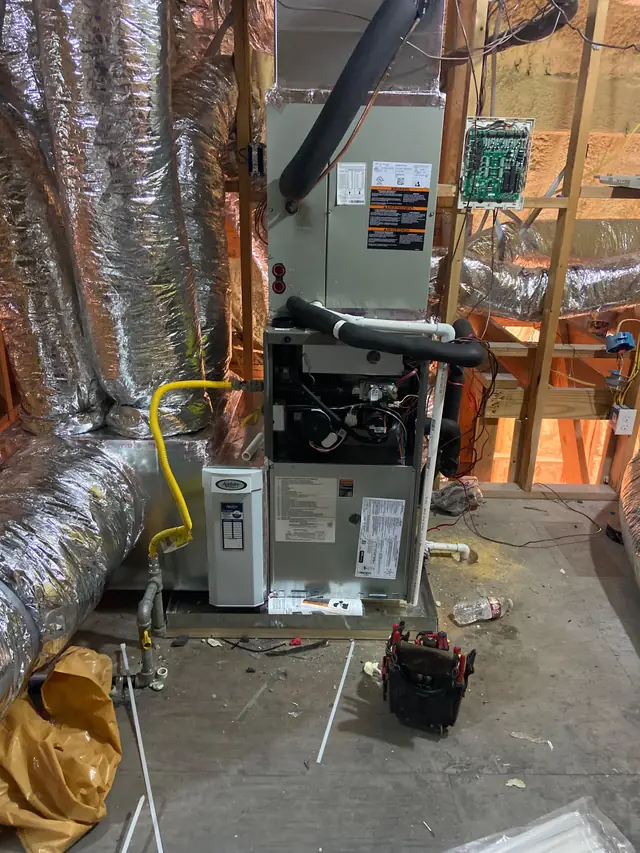
American Standard air handler with an Aprilaire media air cleaner cabinet and gas flex line in an attic
Matched to the problem: a media air cleaner or a dehumidifier
A media air cleaner is a deep pleated filter in its own cabinet, fitted to the air handler so that all the air the system moves passes through it. One of ASR's attic installs shows exactly this: an American Standard air handler with an Aprilaire media cabinet beside the furnace compartment. A cabinet like that holds far more filter surface than a standard one-inch slot, and how often its filter is replaced depends on the model, so ask the installer for the schedule.
A whole-home dehumidifier is a different tool for a different problem. It removes moisture from the air itself, connected to the ductwork, instead of leaving the air conditioner to do that as a side effect of cooling. It tends to make sense when the system reaches the thermostat setting but the house still feels damp, which can happen in mild, wet weather or with an oversized system. Whether yours needs one comes back to the humidity reading.
Neither one replaces a sound duct system or a clean coil, and neither is a promise about how a person will feel. Ask for the model, its capacity, where it will be installed, and how its filter or drain will be maintained, so you know what you are buying and what it will take to keep it working in your home.
Gulf Coast humidity and the attic: where the damp air comes from
Tomball sits in the Gulf Coast climate, where outdoor air carries a lot of moisture for much of the year. An air conditioner removes some of it as it cools, but a house stays dry only if outside air is not constantly finding its way back in. Doors, windows and the building envelope matter, and so do the ducts, which is the part nobody sees.
In many Tomball homes the air handler and the duct runs are in the attic, and the attic is hot and humid. If a joint has a gap or a return has a leak, the system can pull attic air into the house while sending cooled air out into the attic. A technician finds that by looking at joints, seals and connections in place, and attic work is shown in our photos of furnace and air handler installs.
That is why testing comes first. An air cleaner will not fix a leaky duct system, and a dehumidifier working against attic air is working against the source. If the reading or a visible duct problem points that way, the finding may be that the ducts need attention before any equipment. ASR Mechanical in Tomball holds Texas HVAC license TACLA85163E. To have someone look, call (281) 351-5354.
"They laid out what needed to be done and let me know that I would NOT need a new unit." T G, Google review, July 2026.