Heating and Furnace Installation · Tomball
Heater and Furnace Installation
A gas furnace or heat pump sized for your house and installed in order, from the attic platform to the start-up test.
Gas furnace or heat pump: the house decides, not the catalog
The first question is what the house already has. A home with a gas line and a furnace space can stay with a gas furnace. A home that wants to cut gas use, or has no good way to vent one, may be a candidate for a heat pump. Either can be right, and a plain conversation about how you heat the house now, which rooms run cold and what the winter bills look like will tell us more than a brochure. ASR sells and installs American Standard equipment as a dealer.
Sizing follows the house: its square footage, insulation, windows, the duct system the new equipment will push air through, and how the old unit actually performed. An oversized furnace short cycles and leaves rooms uneven, and an undersized one runs all night and still falls behind. We look at the ducts before a model is chosen, because new equipment connected to leaking or undersized duct will not fix the problem that made you call.
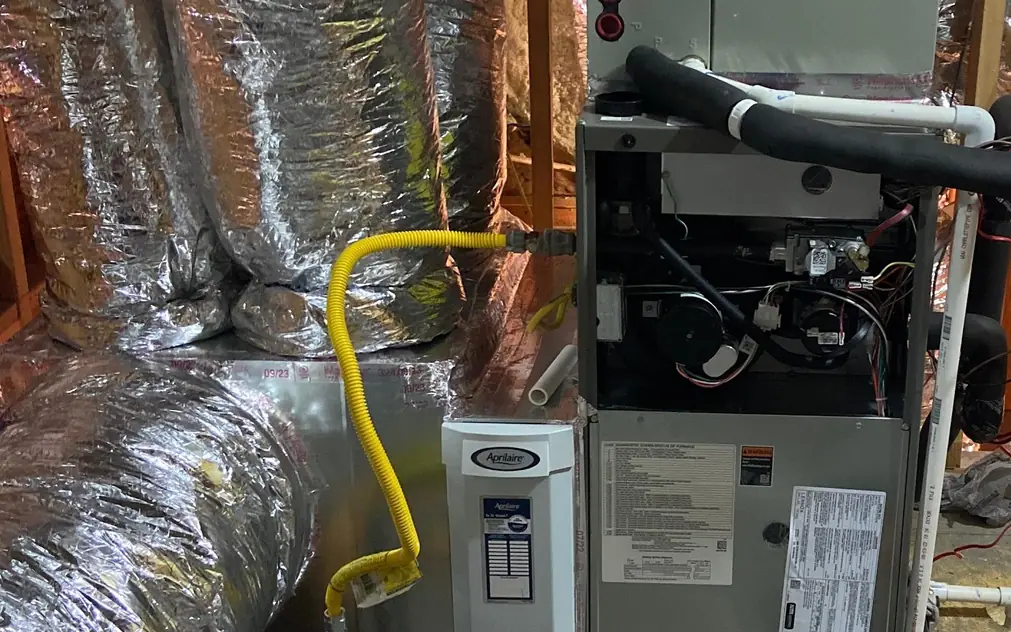
Aprilaire media air cleaner beside the open furnace burner compartment, gas flex and insulated flex duct
Attic install, in order: platform, flue, gas flex, drain, filter access
An attic install is a sequence, and skipping a step costs you later. The platform goes in first, solid and level, with a walkway to the hatch so nobody steps through the ceiling. The furnace or air handler sets on it, the flue is run to the roof jack, and the gas flex connects at the valve with a shutoff in reach. Each of those is easier to get right before the cabinet is boxed in by ductwork than after it.
The condensate drain gets a clear, sloped path out, because a drain that backs up in an attic ends as a stain on the ceiling below. The return and filter are set so that changing a filter is a reach from the hatch rather than a crawl across the joists. On one of our installs an American Standard air handler stands beside an Aprilaire media cabinet with the gas flex already landed, because filtration and access are decided on the first day, not the last.
Start-up is a full test run, and the first winter is the real proof
When the equipment is in, the job is not done until it has run. Start-up means lighting the furnace and watching the flame, checking the gas connections, confirming the blower moves air to every room, and walking the thermostat through a complete heating call from a cold start to shutoff. Anything that does not behave gets fixed before the crew leaves, and the work order shows what was set and what was found.
Then the first cold stretch is the real proof. A check up after that first winter is worth booking, because it catches the thing that only shows up under real load: a filter that loaded sooner than expected, a loose vent joint, a thermostat setting nobody has touched. ASR Mechanical, Texas HVAC license TACLA85163E, installs from the shop on Commercial Park Road in Tomball. Call (281) 351-5354 for an estimate, and if another company has already quoted a full replacement, mention that quote when you call.
“ASR installed both my AC and Heater a few years ago, and I've always used them for check ups and service.” Bailey Curtis, Google review. Texas HVAC license TACLA85163E.
Checked
On the start-up list before the crew leaves
Flame
Lit, watched through a full heating call, steady from cold start to shutoff.
Gas flex
Connected at the valve with a shutoff in reach, then checked for leaks.
Flue
Run clean to the roof jack and looked over before the cabinet is closed.
Condensate drain
Clear, sloped path out, so nothing backs up over the ceiling below.
Filter access
Reachable from the hatch, so the filter actually gets changed.
Replacing a system that keeps failing? Start with the furnace repair page to see what the failed parts look like, and the financing page for how larger projects are paid for. Or call (281) 351-5354.